Every jump costs fuel: jumps and warp fuel
Published
In short: ships jump from place to place along fixed links. Every jump burns fuel, short hops are cheap and long trips are expensive, so you plan the way there and the way back.
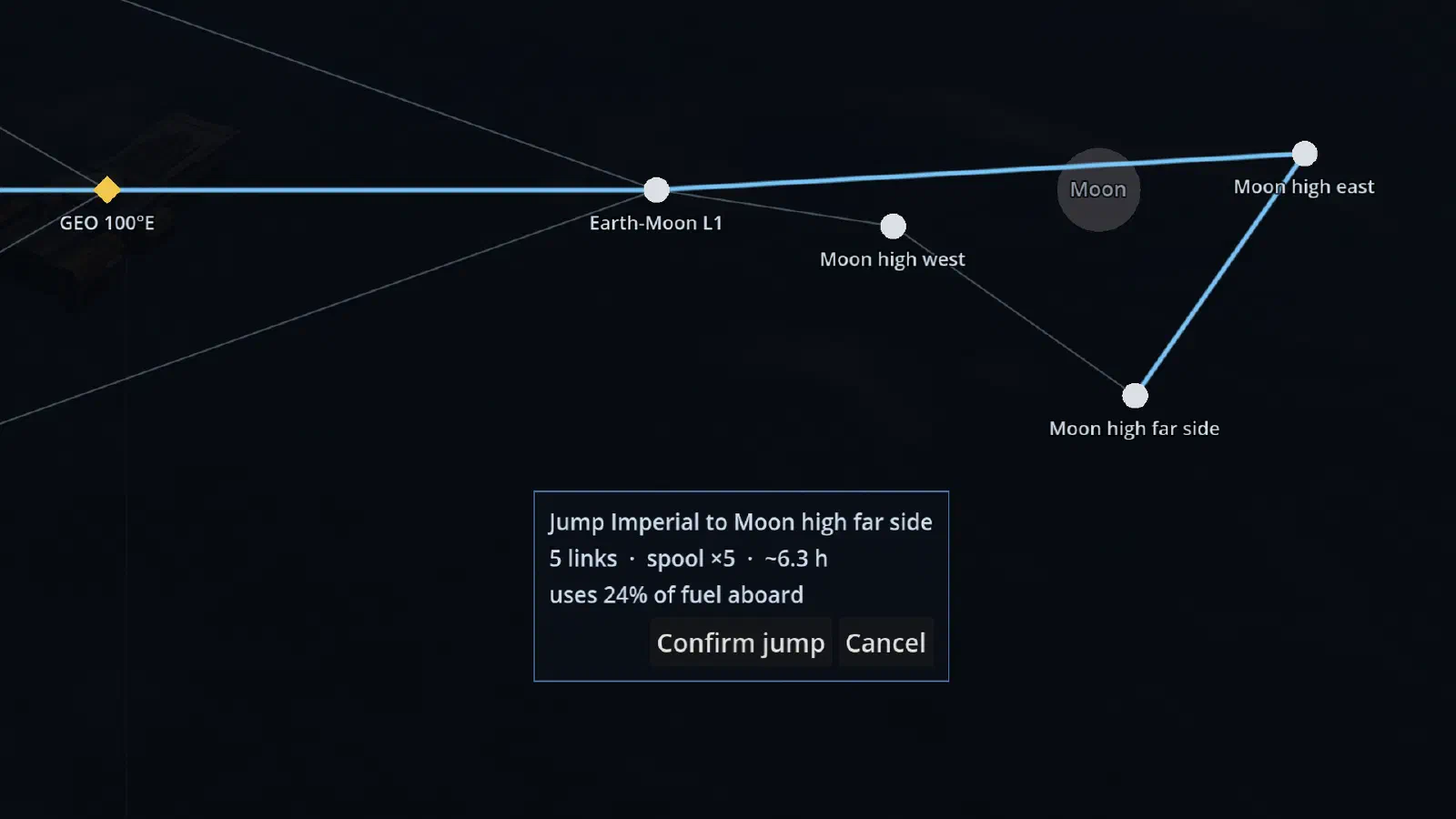
At a glance
| Spool | carrier 12 s, Hawkeye 4 s; fighters can’t jump |
| Flight | a 1 g burn: speed up halfway, flip, brake |
| Fuel | from the rocket equation |
| Range | all the fuel aboard, tanks and hold |
How it works
- The spool doesn’t stop you. A ship keeps moving while its drive spools, so a jump is a dependable way out. In a planet’s air, jumps leave only from the Top band.
- Heavier costs more. A fuller hold burns more fuel, and far trips cost far more, because you are pushing your own fuel along.
- Carry more fuel in tank containers in the hold. Hot drops and burns cost nothing.
- The node map (F4) plans routes over several links and shows the total fuel and trip time, with “CAN’T RETURN” in red when the fuel left wouldn’t bring you back.
- No shortcuts: jumps go link by link, and nothing jumps through a planet.
More: jump drives and fuel, the Tsiolkovsky rocket equation, travel nodes.