The dice decide, the jets act it out: dogfights
Published
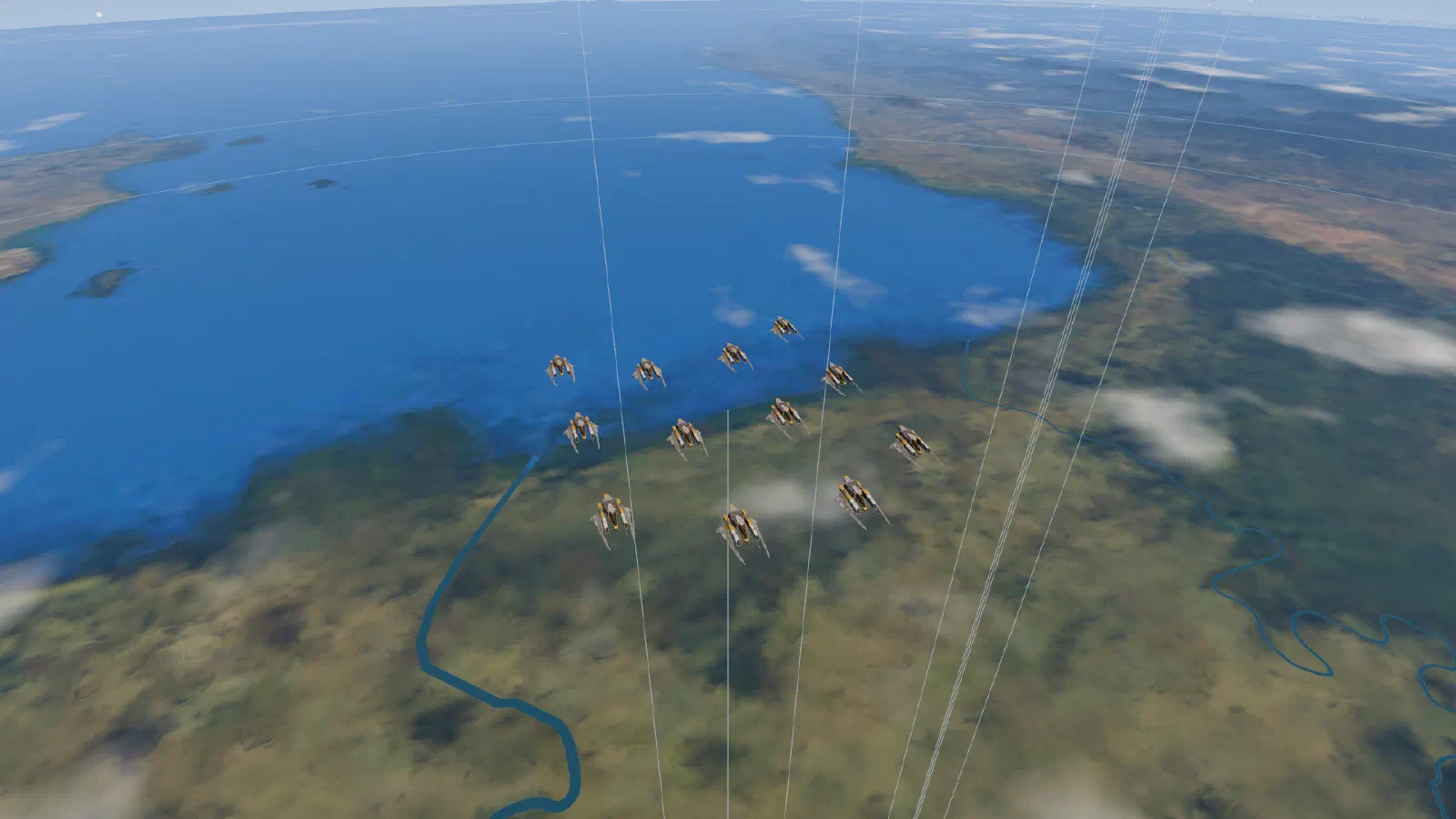
In short: stats decide the fight; the flying is the show. Every round is rolled on the shooter’s attack and the target’s defence, both set by Mark. Squadrons hold formation on the way in, break into passes at the merge, and form up again after.
At a glance
| Hit chance | 35 % + attack − defence, from 8 % to 90 % |
| Fighter guns | +10 attack against fighters |
| Attack and defence | 10 / 25 / 40 / 55 for Mk0 to Mk3 |
| Equal Marks | 45 % |
| Mk3 on a Mk1 | 75 % |
| Mk1 on a Mk3 | 15 % |
| Guns | bursts of 8 rounds, about 2 rounds a second on average |
| Two equal squadrons | about 3 minutes |
Every round is rolled
The hit chance is 35 % plus the shooter’s attack minus the target’s defence, never below 8 % or above 90 %. A fighter’s gun gets +10 attack against fighters, so equal fighters hit each other 45 % of the time. An evasive fighter gets +30 defence, but its guns are off.
Fighters don’t aim with a gun cone: in range, a fighter fires. Guns fire bursts of 8 rounds with a pause after each, so a magazine lasts about one fight. Turrets work the same way; see below. More: guns and ranges.
How it looks
- Slowing for the fight. Once enemies are close, inside their contact ring (about 2.4 km for Mk1s), fighters slow to half their top speed. Two groups meet, pass, and swing straight back in instead of overshooting by kilometres.
- Always moving. In a fight, fighters circle the enemy at half their gun range, nose on the target, and slide out of the enemy’s line of fire when they can.
- Squadrons break into passes. On the approach a squadron holds its three chevrons. At the merge the jets peel off a few at a time into passes: attack, break away, turn back, jink when shot at, each on its own enemy jet, inside the squadron’s fight circle. After the fight they drift back into formation one by one.
It is choreography: the dice decide, the jets act it out, and a kill always shows on the jet that was hit.
Every jet counts
Each jet in a squadron has its own hull and ammunition. Damage spreads over the squadron’s jets, a jet goes down when its own hull is gone, and a downed jet takes its unused rounds with it.
Piling on
When several units fight the same target, each hits it 1/N as often, where N is how many are on it. Together they put on it exactly what one would, however many pile on. In a crowd you hold fire for fear of hitting your own side.
- What piling on buys: the target’s fire is split over all its attackers. Each of its jets picks one of them at random, more jets being more likely to be picked, so each attacker takes less damage.
- What it costs: those units aren’t fighting anywhere else.
- Mixed Marks: each attacker still gets its share of its own hit chance. A Mk2 and a Mk1 on one target each fire at half their own rate.
- Picking targets: units still prefer enemies nobody else is on.
In testing, three Mk1 squadrons on one killed it in about 3 minutes, as long as a fair one-on-one, and lost only 1, 0 and 1 jets.
Turrets
The carrier’s point defence turrets fight by the same rules:
- Same roll: 35 % plus the turret’s attack for its Mark, plus 15 against fighters, minus the target’s defence.
- No firing arcs: in range, a turret fires, in bursts of 16 rounds, about 8 a second on average. The barrel swings to show where.
- No dodging, but hard to kill. Each turret is worth about one Mk1 squadron in firepower and toughness, so a carrier with three turrets is worth about three squadrons.
- They count when piling on, like any unit: three turrets on one squadron put on it what one turret would.
To take a carrier, bring about three squadrons, one per turret, or a higher Mark. In testing, a lone Mk1 squadron against three Mk1 turrets broke off at half strength after about 90 seconds.
How long
Two equal squadrons take about 3 minutes. Five or six squadrons a side took about 5 minutes in testing, over a few runs; results vary.
Stances in a fight
Reckless and cautious fight the same way. Cautious breaks off, turning evasive, at half its hull; a squadron at half its jets’ hull. Out of ammunition, any fighter turns evasive and heads for a rearm at the carrier. More: pilot stances.
Planned
Hero ships, single top-of-the-line ships with about twelve times a fighter’s hull; bombers, poor dogfighters that need escorts; morale; flanking; the carrier’s own hull in a fight; and repairing turrets.
More: Marks, squadrons, simulation: try a fight first.